RTPi
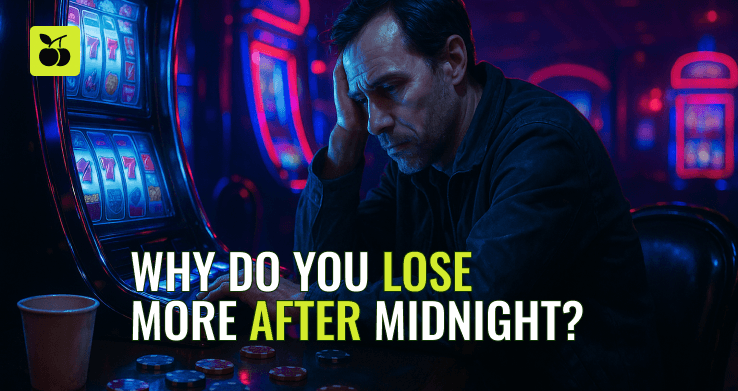
The city falls asleep, excitement wakes up: Is it true that people lose more often at night?
The key advantage of online gambling is its round-the-clock availability. With the day's hustle and bustle and the city sinking into sleep, it's the perfect time for many players to try their luck. However, playing under the cover of night has its own peculiarities, which are increasingly attracting the attention of not only researchers, but also regulators. Are night gaming sessions really more dangerous than daytime ones and why?
Fatigue Factor: Science vs. Late-Night Gamblers
The main argument in favor of the fact that players lose more at night lies in psychophysiology. After a hard day, a person's cognitive functions naturally decline. Accumulated fatigue, lack of distractions and nowhere to rush create ideal conditions for long gaming sessions.
The British Gambling Commission (UKGC) notes that it is during the night hours that longer gaming marathons are recorded. According to their data, 6% of online slots sessions last more than an hour, which is significantly higher than the average game duration of 17 minutes. This turns the night audience into a "risk group".
Scientific research supports these fears. Japanese scientists have found that after midnight, players tend to make larger bets and are more likely to make desperate "attempts to win back". Problem gamblers, who already spend many times more on gambling, only aggravate their situation at night.
The experiment, the results of which were published in the prestigious journal Nature, showed that after 19 hours of wakefulness, people significantly slow down their decision-making speed and increase irritability, although the size of the bets may not change. Another American study confirms the obvious: lack of sleep makes a person more impulsive and weakens self-control. This is the key to understanding the phenomenon of night gambling – losses happen more often not because of a mystical "failure", but because of fatigue and poorer, balanced decisions.
Regulators' response: from monitoring to restrictions
Gambling regulators around the world could not ignore this problem. The same UKGC recorded an increase in gross gambling revenue (GGY is the amount of bets minus winnings) in the online segment by 7%, and the number of game rounds (spins) increased by 6%. A significant contribution to these numbers was made by players with long, often nightly, sessions.
In response to the growing risks, some jurisdictions are already taking action. Regulators in countries such as Sweden and Malta have officially included nightly gambling activity in the list of risk factors for addiction. This obliges operators to monitor the behavior of such players more closely. The Council of Europe also calls on other countries to tighten control over this problem, up to the introduction of direct restrictions on playing at night.
Control tools and the human factor
Against the backdrop of these trends, the role of responsible gambling tools is increasing. Although there are no comprehensive statistics on their nightly effectiveness yet, logic suggests that they can be especially useful. The Identity Verification (KYC) procedure, which may seem tedious during the day, is even more likely to force the player to postpone the game at night.
Modern approaches such as AI-powered game session monitoring, automatic limit enforcement, and timely notifications from customer support can help reduce the number of "hardcore night owls." However, it should be recognized that these measures are effective mainly in the legal market, while the shadow segment of the industry is only happy to take advantage of the vulnerability of night players.
Inference? Playing with a fresh head is always a wiser decision. Now you know why night trips to online casinos often end in disappointment. And while the idea of special bonuses for night gambling could be a high-profile marketing campaign, the gambling community would most likely criticize such an initiative for encouraging risky behavior.
Write a comment...